hip arthroscopy recovery timeline
Hip Arthroscopy Recovery Timeline From Surgery to Returning to Activity
Introduction
Recovering from hip arthroscopy is a gradual process. Although arthroscopy uses small incisions and minimally invasive techniques, the structures treated inside the hip still need time to heal. Returning to normal activity too quickly can interfere with recovery, while progressing too slowly may contribute to unnecessary stiffness and weakness.
At Dr. Hunter Orthopedic Surgery, recovery planning is individualized according to the procedure performed, the condition being treated, the patient's overall health, and their activity goals. A hip arthroscopy recovery timeline can provide useful milestones, but patients should progress according to their surgeon's and rehabilitation team's recommendations rather than relying on a calendar alone.
For active adults and athletes, recovery typically progresses from protecting the hip and restoring basic mobility to rebuilding strength, improving movement control, and eventually returning to higher-impact exercise and sports.
TLDR – Quick Guide
- Hip arthroscopy recovery progresses through several stages rather than happening all at once.
- Early recovery focuses on protecting the repaired tissues, controlling discomfort, and restoring safe mobility.
- Crutches or other walking assistance may be needed temporarily depending on the procedure.
- Physical therapy is an important part of restoring range of motion, strength, and hip stability.
- Patients gradually progress from everyday activities to more demanding exercise.
- Running, cycling, and sports should resume only after appropriate strength and movement milestones are achieved.
- Recovery time varies considerably depending on what was treated during surgery.
- Learn more about Hip Arthroscopy and the conditions that may be treated with minimally invasive surgery.
What Happens During Hip Arthroscopy?
Understanding the Procedure Before Recovery Begins
Hip arthroscopy is a minimally invasive procedure that allows an orthopedic surgeon to access the hip joint through small incisions. A small camera and specialized surgical instruments are used to evaluate and treat certain problems inside and around the joint.
The exact procedure varies according to the patient's diagnosis. Hip arthroscopy may be used to address conditions such as Hip Labral Tears or structural problems associated with Femoroacetabular Impingement (FAI).
Because different procedures involve different amounts of tissue healing, there is no single recovery schedule that applies to every patient. Someone undergoing a relatively limited procedure may progress differently from a patient who requires more extensive treatment inside the joint.
The First Few Days After Hip Arthroscopy
Protecting the Hip and Managing Early Symptoms
The first several days after surgery generally focus on controlling pain and swelling while protecting the tissues treated during the procedure.
Patients may experience soreness, stiffness, swelling, and temporary weakness around the hip. Medications and ice may be recommended as part of the postoperative plan, and patients should carefully follow instructions regarding incision care and activity.
Walking may initially require crutches or another assistive device. How much weight can safely be placed on the surgical leg depends on the procedure performed and the surgeon's specific instructions.
Even during this protective stage, appropriate movement is often encouraged. The objective is to begin recovery without placing unnecessary stress on healing structures.
The First Two Weeks
Establishing Safe Mobility
During the early weeks, the emphasis gradually shifts toward improving comfortable movement and becoming more independent with everyday activities.
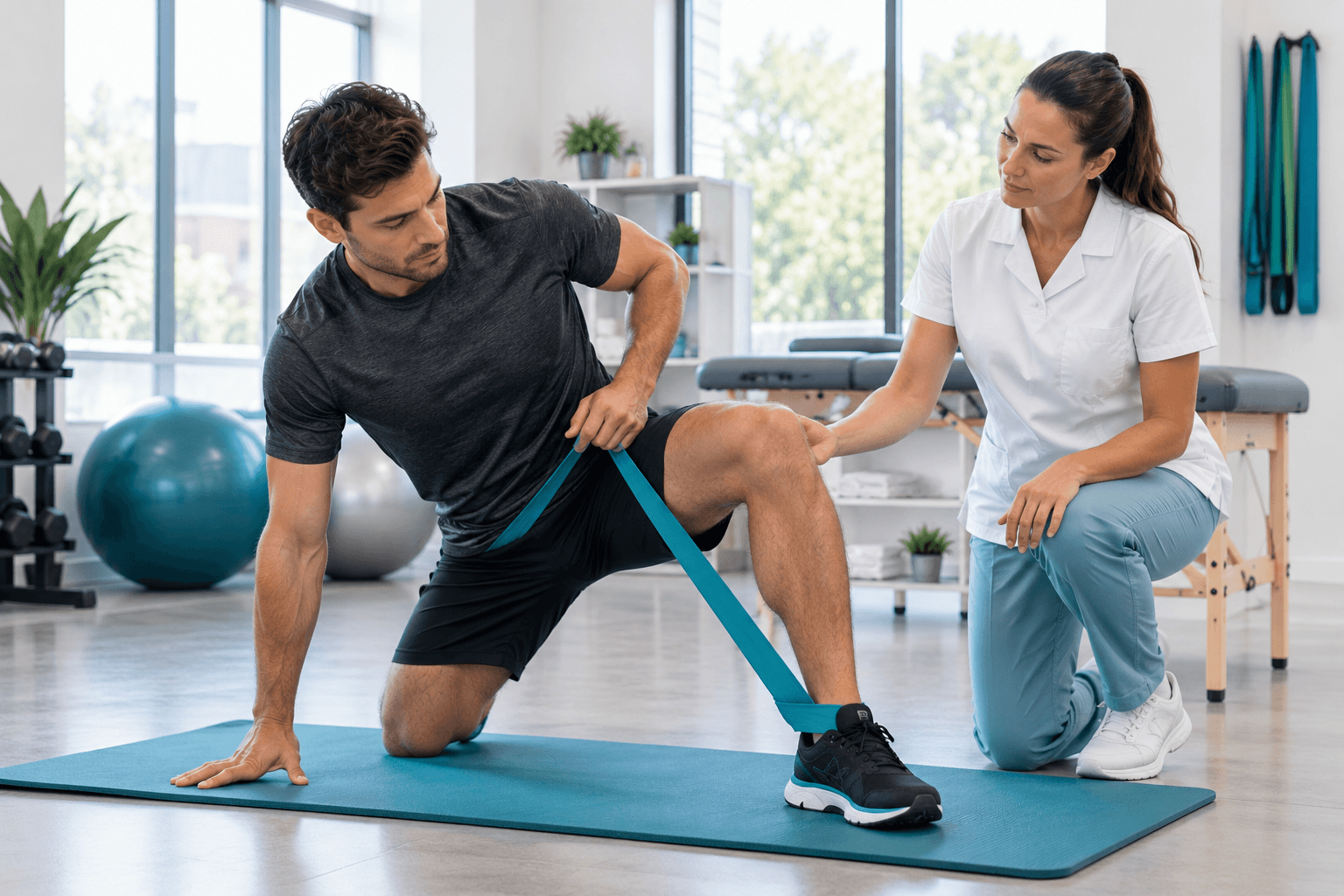
Physical therapy may begin according to the postoperative plan. Early rehabilitation can include gentle range-of-motion exercises, muscle activation, and strategies for moving safely during daily tasks.
Patients should avoid interpreting reduced pain as proof that the hip is fully healed. The tissues inside the joint are still recovering even when walking and basic activities begin to feel easier.
Following restrictions during this stage helps create a foundation for the more active phases of rehabilitation that follow.
Weeks Two Through Six
Restoring Movement and Building Basic Strength
As healing progresses, rehabilitation typically becomes more active.
Patients may gradually work toward improving hip mobility, normalizing their walking pattern, and strengthening the muscles around the hip and pelvis. The gluteal muscles and core are particularly important because they contribute to pelvic stability and lower-extremity control.
Exercises are usually advanced according to symptoms and functional progress rather than simply because a certain number of weeks have passed.
Some patients may begin transitioning away from crutches during this period when permitted by their surgeon. Others may need additional time depending on the procedure performed and the condition of the joint.
Weeks Six Through Twelve
Building Strength and Functional Control
The middle stage of the hip arthroscopy recovery timeline often focuses more heavily on strength, endurance, balance, and movement quality.
By this point, many patients are performing increasingly challenging rehabilitation exercises. Activities may be designed to improve control during movements such as stepping, squatting, climbing stairs, and other functional tasks.
The goal is not simply to make the hip stronger in isolation. Rehabilitation should help the hip work effectively with the pelvis, core, knee, and rest of the lower extremity.
Patients may feel substantially better during this period, but returning immediately to unrestricted exercise can still overload tissues that are adapting to increased demands.
When Can You Return to Normal Daily Activities?
Function Returns Gradually
The timeline for returning to work, driving, household responsibilities, and other daily activities depends on the physical demands involved.
A patient with a sedentary occupation may be able to resume certain responsibilities earlier than someone whose job requires prolonged standing, lifting, climbing, or repetitive movement. Driving also depends on factors such as which hip was treated, medication use, strength, comfort, and the ability to react safely.
Rather than treating return-to-work or return-to-driving dates as universal milestones, patients should discuss their individual requirements with their surgical team.
The same principle applies to household activities. Tasks should be gradually reintroduced as mobility and strength improve.
When Can You Start Cycling Again?
Low-Impact Exercise May Return Before Running
Cycling can play a useful role during rehabilitation because it provides cardiovascular exercise with less impact than running.
A stationary bike may sometimes be incorporated earlier in rehabilitation when permitted by the surgeon and physical therapist. Resistance and duration can then be increased progressively as the hip becomes stronger and more comfortable.
Outdoor cycling introduces additional challenges, including balance, hills, traffic, sudden stops, and the possibility of falling. Patients therefore need adequate strength, control, and confidence before transitioning from controlled indoor exercise to outdoor riding.
For additional guidance, review Returning to Cycling or Running After Surgery.
When Can You Run After Hip Arthroscopy?
Running Requires More Than Being Pain-Free
Running places considerably greater forces through the hip than walking or stationary cycling.
Before beginning a running progression, patients generally need adequate hip strength, good single-leg control, appropriate mobility, and the ability to perform lower-impact exercises without increased symptoms.
Being able to walk without pain does not automatically mean the hip is ready for running. Rehabilitation should progressively prepare the joint and surrounding muscles for repeated impact.
When running is reintroduced, it is generally better to begin gradually rather than immediately returning to previous mileage or speed. Symptoms during and after exercise can help the rehabilitation team determine whether progression is appropriate.
Returning to Sports After Hip Arthroscopy
Sport-Specific Demands Require Additional Preparation
Returning to sports requires more than restoring basic strength.
Athletes may need to regain acceleration, deceleration, balance, rotational control, endurance, and the ability to change direction safely. The requirements differ substantially between activities such as golf, cycling, running, soccer, tennis, and contact sports.
A structured Sports Medicine approach can help evaluate whether the hip and surrounding muscles are prepared for the specific demands of an athlete's activity.
Return-to-sport decisions should therefore be based on function and readiness rather than simply reaching a predetermined postoperative date.
What Can Slow Down Hip Arthroscopy Recovery?
Several Factors Influence the Timeline
Two patients undergoing hip arthroscopy may have very different recovery experiences.
Factors that can influence recovery include the specific condition treated, the amount of tissue damage present, the procedure performed, preoperative strength and mobility, overall health, rehabilitation consistency, and the physical demands of the activities the patient wants to resume.
Doing too much too soon can also contribute to setbacks. Increased soreness after progressing an exercise does not always mean something has been damaged, but repeatedly exceeding the hip's current capacity can make rehabilitation more difficult.
Following an individualized progression helps balance tissue protection with the need to rebuild strength and mobility.
How Do Labral Tears Affect Recovery?
Tissue Healing Influences Rehabilitation
A labral tear can affect both the surgical procedure and the rehabilitation plan.
When the labrum is treated during arthroscopy, the repaired tissue requires appropriate protection as healing begins. Restrictions on weight-bearing, range of motion, or certain exercises may therefore be incorporated into the early recovery plan.
Patients recovering from Hip Labral Tears should follow procedure-specific instructions rather than comparing their progress with someone who underwent a different type of hip arthroscopy.
Protecting healing tissue early can support more effective progression later in rehabilitation.
How Does FAI Affect Hip Arthroscopy Recovery?
Correcting Impingement Is Only Part of Recovery
Femoroacetabular impingement involves abnormal contact between structures within the hip. When arthroscopy is used to treat FAI, surgery may address structural abnormalities contributing to that contact as well as associated damage within the joint.
Rehabilitation then focuses on restoring comfortable movement, strength, and control without immediately returning the hip to repetitive positions that previously produced symptoms.
Patients treated for Femoroacetabular Impingement (FAI) may therefore need time to adjust movement patterns in addition to allowing the surgical area to heal.
A successful recovery involves both biological healing and gradual restoration of efficient movement.
Why Physical Therapy Matters
Rehabilitation Bridges Surgery and Activity
Surgery addresses structural problems inside the hip, but rehabilitation helps patients regain the physical capacity needed for everyday life and sports.
Physical therapy may progressively address mobility, strength, balance, endurance, and movement mechanics. Later stages can include increasingly demanding exercises based on the activities the patient hopes to resume.
Skipping rehabilitation milestones or progressing solely because pain has improved can leave important strength or control deficits unaddressed.
Consistent rehabilitation helps create a safer transition between surgery and unrestricted activity.
When Should You Contact Your Surgeon During Recovery?
Recognize Symptoms That Need Medical Attention
Some soreness and temporary fluctuations in discomfort can occur as activity increases during rehabilitation. However, patients should follow their postoperative instructions regarding symptoms that require medical evaluation.
Contact your surgical team if you experience significant or worsening pain, concerning incision changes, fever, unexpected swelling, new weakness or numbness, or another symptom that causes concern.
You should also speak with your surgeon or rehabilitation team if progress appears to stall or previously manageable activities begin consistently producing significant symptoms.
Early communication allows the recovery plan to be adjusted when necessary.
Key Takeaways
- The hip arthroscopy recovery timeline varies according to the procedure performed and the condition being treated.
- Early recovery focuses on protecting healing tissues and restoring safe mobility.
- Crutches or temporary weight-bearing restrictions may be required for some procedures.
- Physical therapy gradually restores mobility, strength, stability, and movement control.
- Everyday activities often return before higher-impact exercise.
- Cycling may be introduced before running when appropriate.
- Being pain-free during walking does not automatically mean the hip is ready for running or sports.
- Return to activity should be based on functional milestones as well as time since surgery.
- Labral treatment and FAI correction can influence rehabilitation restrictions and progression.
- Following an individualized rehabilitation plan can help patients return to activity without unnecessarily rushing recovery.
FAQs
How long does recovery from hip arthroscopy usually take?
Recovery time varies depending on the procedure performed, the condition treated, and the patient's activity goals. Basic daily activities may return considerably earlier than running, competitive sports, or other demanding exercise. Your surgeon and rehabilitation team can provide a more individualized timeline based on your progress.
How long will I need crutches after hip arthroscopy?
The length of time crutches are needed depends on what was performed during surgery and the postoperative weight-bearing instructions. Some patients transition away from crutches relatively early, while others require them for a longer period to protect healing tissues. Follow your surgeon's specific instructions rather than discontinuing crutches based only on reduced pain.
When can I start exercising after hip arthroscopy?
Gentle rehabilitation may begin relatively early, but the type and intensity of exercise should progress gradually. Lower-impact activities are typically introduced before running, jumping, or sport-specific training. Your rehabilitation plan should determine when each activity is appropriate based on healing, strength, mobility, and movement control.
When can I run after hip arthroscopy?
Running should generally begin only after adequate strength, mobility, balance, and lower-extremity control have returned. The exact timing varies because different arthroscopic procedures require different healing periods and rehabilitation restrictions. When cleared, patients typically benefit from a gradual running progression rather than immediately returning to previous mileage or intensity.
How do I know when I am ready to return to sports?
Return-to-sport readiness involves more than simply being pain-free or reaching a certain number of weeks after surgery. Strength, endurance, balance, movement quality, and the ability to perform sport-specific tasks should be considered before unrestricted participation. Your surgeon and rehabilitation team can assess these factors and determine when progression is appropriate.
Ready to discuss your hip or knee concerns with Dr. Hunter?