hip labral tear treatment
Hip Labral Tear Treatment Options and When Surgery May Be Needed
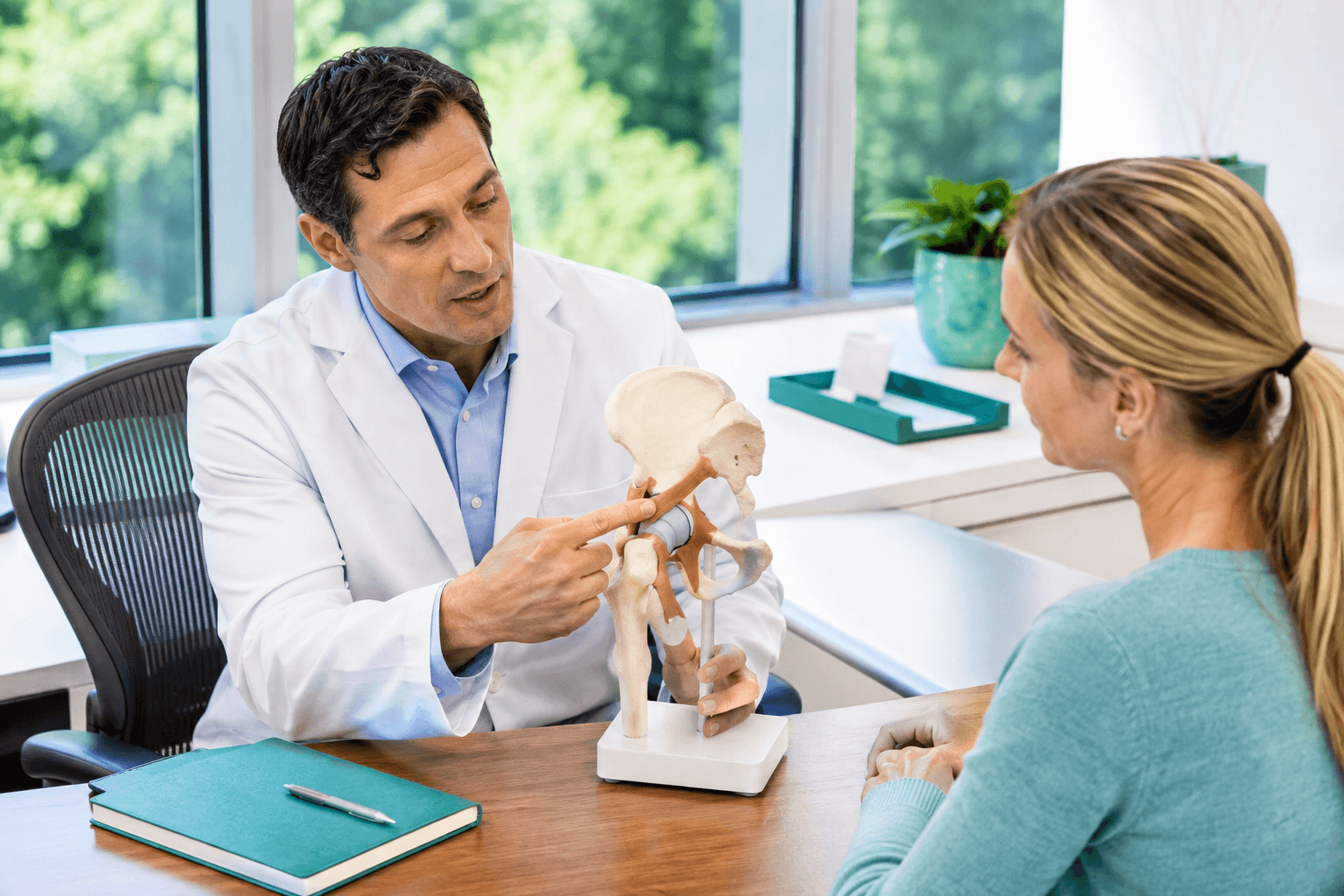
Introduction
A hip labral tear can cause persistent groin or hip pain, stiffness, clicking, catching, and difficulty with activities that require twisting or deep hip movement. While receiving a diagnosis can be concerning, a labral tear does not automatically mean surgery is necessary. Many patients begin with conservative treatment designed to reduce symptoms and improve how the hip functions.
At Dr. Hunter Orthopedic Surgery, treatment decisions are individualized according to the patient's symptoms, activity level, joint health, imaging findings, and long-term goals. The right hip labral tear treatment depends not simply on whether a tear appears on imaging, but on whether the injury is actually responsible for pain and functional limitations.
Understanding the full range of treatment options can help patients know when conservative care may be appropriate and when persistent symptoms warrant a conversation about surgical treatment.
TLDR – Quick Guide
- Not every hip labral tear requires surgery.
- Initial treatment may include activity modification, physical therapy, and appropriate pain management.
- Physical therapy focuses on strength, stability, mobility, and movement mechanics.
- Injections may sometimes be considered for symptom relief or diagnostic purposes.
- Persistent pain, catching, or functional limitations despite conservative care may warrant further evaluation.
- Hip arthroscopy can treat certain labral tears and associated structural problems.
- Advanced joint degeneration may change which surgical treatment is appropriate.
- Learn more about Hip Labral Tears and how they are evaluated.
What Is a Hip Labral Tear?
Understanding the Role of the Labrum
The hip is a ball-and-socket joint, and the labrum is a ring of cartilage that surrounds the edge of the socket. It contributes to joint stability and helps create a seal around the femoral head as the hip moves.
A labral tear occurs when this cartilage becomes damaged. Tears may develop following a traumatic injury, repetitive athletic movements, structural abnormalities of the hip, or gradual degeneration.
Symptoms can vary significantly. Some patients experience sharp groin pain, while others notice a persistent ache, stiffness, clicking, catching, or discomfort during prolonged sitting, running, pivoting, or squatting.
Because some labral tears may be present without causing significant symptoms, treatment should address the patient rather than imaging findings alone.
Can a Hip Labral Tear Be Treated Without Surgery?
Conservative Care Is Often the First Step
For many patients, hip labral tear treatment begins with nonsurgical strategies.
The objective is to decrease irritation around the hip, improve supporting muscle strength, correct movement patterns that aggravate symptoms, and determine whether the patient can return to desired activities without surgery.
The appropriate approach depends on the severity of symptoms and the underlying cause of the tear. A recreational athlete with occasional discomfort may require a different strategy from someone experiencing persistent pain during everyday activities.
A comprehensive evaluation can help determine whether conservative treatment is likely to provide adequate relief.
How Activity Modification Can Reduce Symptoms
Give the Hip an Opportunity to Settle
Certain movements can repeatedly aggravate a labral tear.
Activities involving deep hip flexion, twisting, pivoting, repetitive impact, or prolonged sitting may increase symptoms in some patients. Temporarily reducing or modifying these activities can decrease irritation while rehabilitation addresses the factors contributing to pain.
Activity modification does not necessarily mean becoming inactive. Patients may be able to substitute lower-impact exercises, adjust training volume, or change movement patterns while maintaining overall conditioning.
The objective is to stay appropriately active without repeatedly provoking symptoms.
Physical Therapy for a Hip Labral Tear
Improving Strength and Movement Control
Physical therapy can be an important component of nonsurgical hip labral tear treatment.
Rehabilitation may focus on strengthening the muscles surrounding the hip and pelvis, particularly the gluteal and core muscles. Better muscular support can improve joint control and reduce unnecessary stress during everyday and athletic movements.
Therapy may also address mobility restrictions and movement mechanics. Rather than repeatedly forcing the hip into painful positions, treatment generally emphasizes comfortable functional movement and better control throughout the available range of motion.
Patients who respond well to rehabilitation may be able to manage symptoms without surgical intervention.
Managing Pain and Inflammation
Symptom Relief Can Support Rehabilitation
Pain management may help patients remain comfortable enough to participate in rehabilitation and normal daily activities.
Depending on the patient's health and medical history, a healthcare professional may recommend appropriate medications or other strategies to manage discomfort and inflammation. These measures do not physically repair a torn labrum, but they can reduce symptoms while other aspects of treatment address strength and function.
Patients should discuss medication use with their healthcare provider rather than relying on prolonged self-treatment for persistent hip pain.
Are Hip Injections an Option?
Diagnostic and Therapeutic Uses
In selected cases, an injection into the hip joint may be considered as part of treatment or diagnosis.
Temporary pain relief following an injection can sometimes help determine whether symptoms are primarily originating from inside the hip joint. This can be particularly useful when imaging identifies several possible sources of discomfort.
Injections may also provide temporary symptom relief that allows a patient to participate more comfortably in physical therapy. However, they do not correct the underlying structural cause of a labral tear and are generally considered one component of a broader treatment strategy.
How Long Should You Try Nonsurgical Treatment?
Look for Functional Improvement
There is no single conservative treatment timeline that applies to every hip labral tear.
Some patients notice meaningful improvement after modifying activities and completing a focused rehabilitation program. Others continue experiencing pain despite consistently following their treatment plan.
Rather than focusing exclusively on the number of weeks that have passed, consider whether function is improving. Less pain, greater mobility, improved strength, and an increased ability to perform desired activities are signs that conservative treatment may be working.
When symptoms remain significant or continue interfering with everyday life, additional orthopedic evaluation may be appropriate.
When May Surgery Be Needed for a Hip Labral Tear?
Persistent Symptoms Can Change the Treatment Plan
Surgery may become an option when a symptomatic labral tear continues to cause substantial problems despite an appropriate course of conservative care.
Factors that may lead to a surgical discussion include persistent groin or hip pain, mechanical catching or locking, difficulty participating in sports, reduced mobility, or limitations that interfere with everyday activities.
Imaging findings may also reveal structural abnormalities contributing to repeated labral damage. However, the decision to proceed with surgery should consider symptoms, examination findings, joint health, activity goals, and response to nonsurgical treatment together.
How Hip Arthroscopy Can Treat Labral Tears
A Minimally Invasive Surgical Approach
When surgery is appropriate, Hip Arthroscopy may be used to evaluate and treat certain problems inside the hip through small incisions.
Depending on the nature of the injury, arthroscopic treatment may address the damaged labrum as well as structural abnormalities contributing to repeated stress within the joint. The exact procedure depends on the location and severity of the tear, cartilage health, and other findings inside the hip.
Patients considering minimally invasive treatment can learn more through Dr. Hunter's guide to Arthroscopic Surgery for Knee & Hip Pain.
Arthroscopy is not automatically appropriate for every labral tear. Careful patient selection is essential for determining whether this approach is likely to address the actual source of symptoms.
What If Joint Degeneration Is Also Present?
Arthritis Can Change the Treatment Strategy
A labral tear may not be the only abnormality identified during a hip evaluation.
Some patients also have cartilage deterioration or more advanced degenerative changes within the joint. When substantial arthritis is present, repairing or treating the labrum alone may not adequately address the primary source of pain.
This distinction becomes especially important when deciding whether hip preservation treatment is likely to provide meaningful long-term improvement. Patients with degenerative changes can learn more in Hip Pain & Joint Degeneration Treatment Options.
Understanding the overall condition of the joint helps prevent treatment from focusing on one imaging finding while overlooking a more significant source of symptoms.
When Does Hip Replacement Enter the Discussion?
Advanced Joint Damage Requires a Different Approach
A hip labral tear by itself does not usually mean a patient needs joint replacement.
However, patients with substantial cartilage loss and advanced arthritis may experience pain primarily because the entire joint has deteriorated. In these situations, arthroscopic treatment of the labrum may not adequately address the underlying problem.
When advanced degeneration causes persistent pain, stiffness, and significant loss of function, Hip Replacement Surgery may be discussed as a more appropriate treatment option.
The distinction between an isolated labral problem and advanced joint degeneration is therefore critical when determining the right surgical strategy.
Why Imaging Alone Should Not Determine Treatment
Symptoms and Joint Function Matter
MRI and other imaging studies can provide valuable information about the labrum and surrounding structures, but they represent only one part of the diagnostic process.
A tear visible on imaging does not necessarily prove that it is responsible for every symptom a patient experiences. Likewise, the size or appearance of a tear does not always predict how much pain or functional limitation it will cause.
A thorough orthopedic evaluation combines imaging with the patient's history, physical examination, movement limitations, and response to previous treatment. This broader approach helps determine whether the labral tear is clinically significant and which treatment strategy is most appropriate.
When Should You See an Orthopedic Specialist?
Persistent Hip Symptoms Deserve Evaluation
Temporary soreness after strenuous exercise may improve with rest, but recurring hip or groin pain should not be ignored.
An orthopedic evaluation is particularly important when symptoms repeatedly return with activity, interfere with walking or exercise, cause catching or locking, limit hip motion, or continue despite rest and activity modification.
Earlier evaluation can help identify whether symptoms are related to a labral tear, structural impingement, arthritis, or another hip condition. Establishing the correct diagnosis is the first step toward choosing an effective treatment plan.
Key Takeaways
- Hip labral tear treatment does not automatically require surgery.
- Activity modification and physical therapy are common first-line treatment strategies.
- Rehabilitation can improve hip strength, stability, mobility, and movement mechanics.
- Pain management may make rehabilitation and everyday activities more comfortable.
- Injections may sometimes provide diagnostic information or temporary symptom relief.
- Persistent pain or mechanical symptoms despite conservative care may warrant surgical evaluation.
- Hip arthroscopy can treat certain labral tears and associated structural abnormalities.
- Significant arthritis or cartilage loss may make arthroscopic treatment less appropriate.
- Hip replacement is generally considered for advanced joint degeneration rather than an isolated labral tear.
- Treatment decisions should consider symptoms, examination findings, imaging, joint health, and personal goals together.
FAQs
Can a hip labral tear heal without surgery?
Some patients can successfully manage symptoms from a hip labral tear without surgery, particularly when pain and functional limitations improve with conservative treatment. Physical therapy and activity modification can strengthen the surrounding muscles and reduce movements that aggravate the joint. Whether surgery is needed depends on the severity of symptoms, underlying structural problems, and response to nonsurgical care.
What exercises are helpful for a hip labral tear?
Rehabilitation commonly focuses on strengthening the glutes and core while improving pelvic stability and comfortable hip mobility. Exercises should be selected according to the patient's symptoms because repeatedly forcing the hip into painful positions can aggravate the joint. A physical therapist can develop an individualized program based on strength, movement mechanics, and activity goals.
How do I know if my hip labral tear needs surgery?
Surgery may be considered when persistent pain, catching, locking, or functional limitations continue despite an appropriate course of conservative treatment. Your orthopedic surgeon will also consider imaging findings, cartilage health, structural abnormalities, and your desired activity level. The presence of a tear on imaging alone does not automatically mean surgery is necessary.
How is a hip labral tear treated with arthroscopy?
Hip arthroscopy uses small incisions and specialized instruments to access the joint and treat certain labral or structural problems. The specific procedure depends on the type of tear, surrounding cartilage, hip anatomy, and other abnormalities identified during evaluation. Your surgeon can determine whether arthroscopic treatment is appropriate based on the overall condition of your hip.
Can a hip labral tear eventually require hip replacement?
An isolated labral tear does not typically require hip replacement surgery. However, patients who also develop advanced arthritis and substantial cartilage loss may eventually need a different treatment because the entire joint has become damaged. Hip replacement is considered based on the severity of joint degeneration, symptoms, functional limitations, and response to conservative treatment.
Ready to discuss your hip or knee concerns with Dr. Hunter?