Introduction
Knee replacement technology continues to evolve, offering surgeons additional tools to plan procedures and position implants with precision. For patients whose arthritis affects only one compartment of the knee, robotic-assisted partial knee replacement may provide a way to treat the damaged area while preserving healthy portions of the joint.
At Dr. Michael Hunter, MD, understanding whether robotic partial knee replacement is appropriate begins with evaluating the location of arthritis, knee alignment, ligament stability, and overall joint condition. Robotic assistance is a surgical technology that can help guide implant positioning, but successful treatment still depends on appropriate patient selection and the surgeon's clinical judgment.
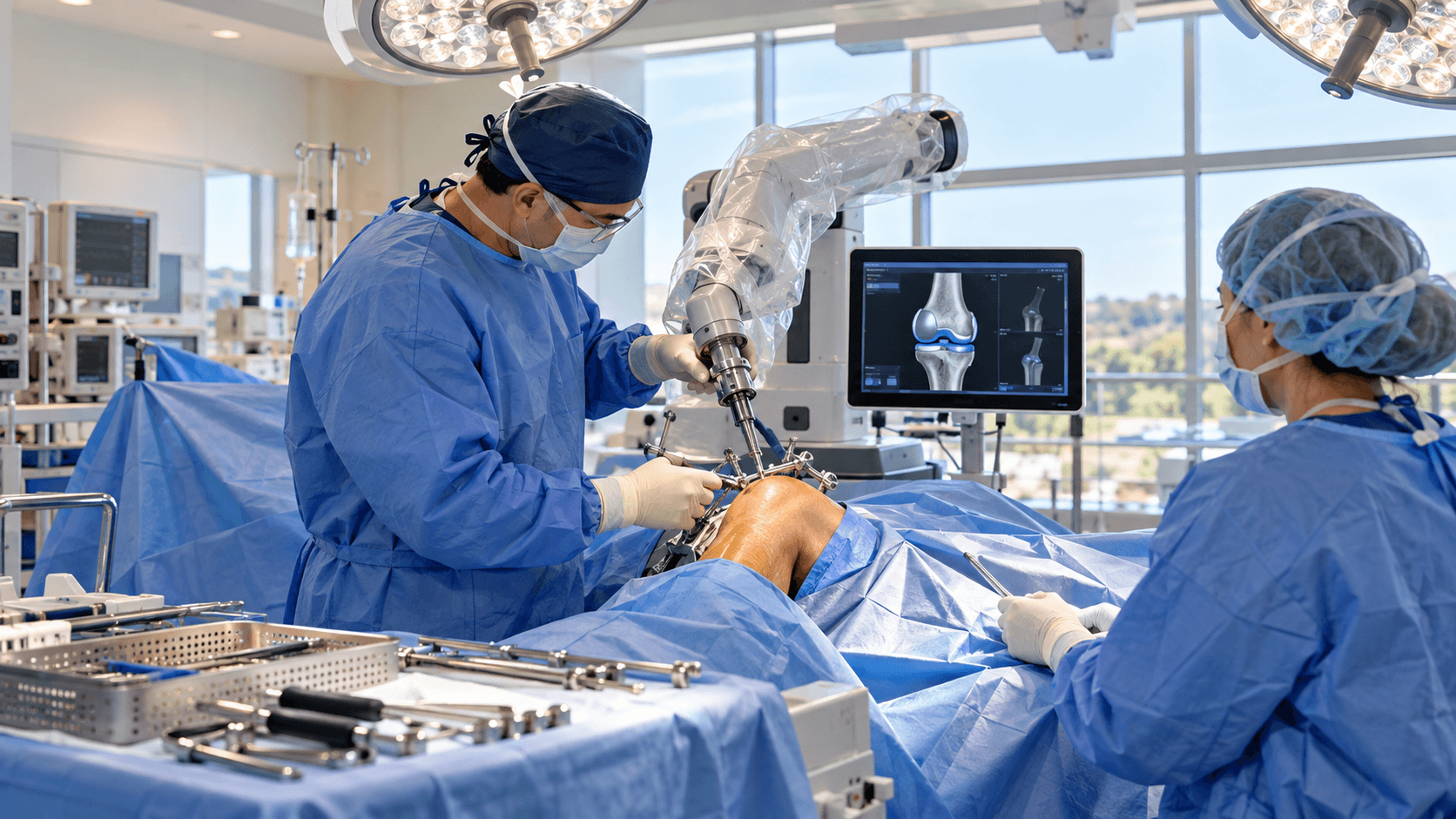
Unlike what the name might suggest, a robot does not independently perform knee replacement surgery. The orthopedic surgeon remains in control of the procedure, using robotic technology to support surgical planning, bone preparation, and component placement.
TLDR – Quick Guide
- Robotic partial knee replacement treats arthritis affecting one compartment of the knee.
- The procedure preserves healthy knee compartments and important natural structures when appropriate.
- Robotic technology helps surgeons plan and execute precise bone preparation and implant positioning.
- Some systems use preoperative CT scans, while others use imaging or measurements collected during surgery.
- The surgeon controls the procedure rather than allowing the robot to operate independently.
- Robotic guidance can help assess knee alignment and ligament balance.
- Potential advantages include accurate component placement and a personalized surgical plan.
- Robotic assistance does not guarantee better outcomes or eliminate surgical risks.
- Recovery generally includes early mobility, physical therapy, and progressive strengthening.
- Patients with arthritis affecting multiple compartments may require total knee replacement instead.
What Is Robotic Partial Knee Replacement?
A Technology-Assisted Approach to Replacing One Knee Compartment
Robotic partial knee replacement is a form of unicompartmental knee arthroplasty that uses robotic assistance during surgical planning and execution.
The knee contains three main compartments:
- Medial compartment: the inner portion of the knee
- Lateral compartment: the outer portion of the knee
- Patellofemoral compartment: the area between the kneecap and femur
When significant arthritis is confined to one compartment, a partial knee replacement may be considered.
The surgeon replaces the damaged joint surfaces while preserving the unaffected compartments.
Robotic assistance helps guide selected parts of the procedure according to the patient's anatomy and the capabilities of the surgical system.
Patients can learn more about the underlying procedure through Dr. Hunter's Partial Knee Replacement Surgery resource.
How Does Robotic Partial Knee Replacement Work?
The Procedure Combines Surgical Expertise With Digital Guidance
Robotic partial knee replacement generally involves several important stages.
These include evaluating the knee, creating a surgical plan, collecting anatomical information, preparing the damaged bone surfaces, positioning the implant components, and confirming joint function.
The robotic system helps the surgeon carry out the planned procedure with controlled guidance.
Different robotic platforms use different technologies, so the exact workflow may vary.
The essential principle remains the same: the surgeon directs the operation while robotic assistance provides information or guidance to support accuracy.
Step 1: Evaluating the Knee Before Surgery
Confirming That Arthritis Is Limited to One Compartment
Before recommending robotic partial knee replacement, the orthopedic surgeon determines whether the patient is an appropriate candidate.
This usually involves reviewing symptoms, medical history, physical examination findings, and imaging.
Important considerations include:
- Location of cartilage damage
- Severity of arthritis
- Knee alignment
- Ligament stability
- Range of motion
- Condition of the remaining compartments
- Previous treatment response
- Functional limitations
Patients with advanced arthritis affecting multiple compartments may not benefit adequately from replacing only one portion of the knee.
An accurate diagnosis is therefore essential before surgical planning begins.
Step 2: Creating a Personalized Surgical Plan
Digital Planning Helps Account for Individual Anatomy
Depending on the robotic platform, the surgeon may use a preoperative CT scan or information collected during surgery to develop a digital representation of the knee.
This information helps guide the planned size, position, and orientation of the replacement components.
The surgical plan may consider:
- Bone anatomy
- Joint surface geometry
- Implant dimensions
- Component alignment
- Bone removal
- Joint balance
- Range of motion
Digital planning allows the surgeon to evaluate important technical details before or during bone preparation.
However, the plan is not necessarily fixed.
The surgeon may make adjustments based on findings during the procedure.
Step 3: Collecting Anatomical Information During Surgery
The System Identifies Important Knee Landmarks
During surgery, robotic-assisted systems may collect information about the patient's knee anatomy and movement.
This process can involve registering anatomical landmarks and tracking the position of the bones.
The system uses this information to relate the surgical plan to the patient's actual anatomy.
Some platforms also allow the surgeon to assess how the knee moves through different positions.
These measurements can help inform implant placement and joint balancing.
The specific process depends on the robotic technology being used.
Step 4: Assessing Knee Alignment and Ligament Balance
The Surgeon Evaluates How the Joint Moves
Successful partial knee replacement requires more than removing damaged cartilage.
The remaining natural structures must work together with the implant to support stable movement.
During surgery, the surgeon evaluates knee alignment, joint spacing, and ligament balance.
Robotic technology may provide additional information about these relationships.
This can help the surgeon adjust the planned component positioning to support appropriate joint mechanics.
Preserving the natural function of the remaining knee structures is one of the important goals of partial knee replacement.
Step 5: Preparing the Damaged Bone Surfaces
Robotic Guidance Helps Control Bone Removal
After confirming the surgical plan, the surgeon prepares the damaged portions of the femur and tibia.
The goal is to remove the appropriate amount of damaged bone and cartilage so the replacement components can fit correctly.
Depending on the platform, robotic technology may guide the surgical instruments or limit their movement to predetermined boundaries.
This can help the surgeon follow the planned bone preparation.
The amount of bone removed depends on the implant design and the patient's anatomy.
Healthy structures are preserved whenever appropriate for the selected procedure.
Step 6: Positioning the Partial Knee Implant
Component Placement Is Important for Joint Function
Once the damaged surfaces have been prepared, the surgeon positions the artificial components.
A partial knee replacement generally includes components that resurface the affected portions of the femur and tibia.
The implant must fit the prepared bone surfaces and function appropriately with the remaining joint structures.
Robotic guidance can help the surgeon position the components according to the surgical plan.
However, final placement and surgical decisions remain the responsibility of the orthopedic surgeon.
Accurate positioning is important because implant alignment and joint balance can influence function, wear, and long-term performance.
Step 7: Checking Knee Movement and Stability
The Surgeon Evaluates the Joint Before Finishing
After the implant components are positioned, the surgeon assesses knee movement and stability.
This may involve moving the knee through a range of motion and evaluating how the components interact with the surrounding structures.
The surgeon checks whether the knee has appropriate balance and function.
Adjustments may be made when necessary.
Once the surgeon is satisfied with the result, the procedure is completed according to the selected surgical technique.
Does the Robot Perform the Surgery by Itself?
The Orthopedic Surgeon Remains in Control
One of the most common misconceptions about robotic knee replacement is that the robot independently performs the operation.
Robotic systems are designed to assist the surgeon rather than replace surgical expertise.
Depending on the system, the technology may provide:
- Anatomical measurements
- Digital surgical planning
- Real-time positional feedback
- Guidance for bone preparation
- Controlled instrument movement
- Implant positioning assistance
The surgeon remains responsible for evaluating the anatomy, directing the procedure, responding to unexpected findings, and making clinical decisions.
Robotic assistance is therefore best understood as an additional surgical tool.
What Is the Difference Between Robotic and Traditional Partial Knee Replacement?
Both Procedures Treat the Same Damaged Compartment
Traditional and robotic-assisted partial knee replacement share the same basic objective.
Both procedures replace the damaged surfaces of one knee compartment while preserving suitable healthy structures.
The primary difference is how the surgeon plans and guides certain parts of the operation.
Traditional surgery relies on conventional instruments and alignment techniques.
Robotic-assisted surgery adds digital planning, anatomical tracking, and guidance features that may help execute the surgical plan.
Both approaches can produce good results when performed appropriately.
Robotic assistance does not automatically make a procedure superior for every patient.
What Are the Potential Benefits of Robotic Partial Knee Replacement?
Technology May Support More Consistent Surgical Precision
Robotic-assisted systems are designed to help surgeons execute component positioning and bone preparation with accuracy.
Potential advantages may include:
- Personalized surgical planning
- Precise bone preparation
- Controlled component positioning
- Intraoperative alignment assessment
- Additional information about ligament balance
- Preservation of suitable healthy knee structures
- Reduced variability in certain technical aspects of surgery
However, improved technical precision does not necessarily translate into better long-term outcomes for every patient.
Results depend on surgical expertise, patient selection, implant design, rehabilitation, and other factors.
Dr. Hunter's article on Robotic Knee Replacement Benefits for Active Adults provides additional information about robotic-assisted knee replacement considerations.
Who Is a Candidate for Robotic Partial Knee Replacement?
Eligibility Depends Primarily on the Knee Condition
The availability of robotic technology does not change the fundamental requirement that partial knee replacement must be appropriate for the patient's arthritis pattern.
Potential candidates generally have:
- Significant arthritis primarily affecting one compartment
- Persistent pain despite appropriate nonsurgical treatment
- Relatively preserved cartilage in the remaining compartments
- Suitable ligament stability
- Appropriate knee alignment
- Functional range of motion
- Symptoms that interfere with everyday activities
The surgeon must also determine whether the patient's anatomy is compatible with the selected implant and surgical approach.
Patients with extensive damage throughout the knee may require a different treatment strategy.
Can Robotic Partial Knee Replacement Treat One-Sided Knee Damage?
Localized Arthritis Is a Common Reason to Consider the Procedure
Partial knee replacement is often considered when arthritis is concentrated on the inner or outer side of the knee.
For example, a patient may have advanced cartilage deterioration in the medial compartment while the lateral and patellofemoral compartments remain relatively healthy.
In that situation, replacing only the affected compartment may be appropriate if the remaining eligibility criteria are met.
The same general principle applies to selected patients with isolated lateral compartment arthritis.
Patients can learn more about this treatment approach through Partial Knee Replacement for One-Sided Knee Damage.
Can Robotic Surgery Treat Advanced Knee Arthritis?
The Distribution of Arthritis Determines the Procedure
Advanced arthritis does not always mean the entire knee needs to be replaced.
If severe cartilage damage is isolated to one compartment, partial knee replacement may still be considered.
However, widespread arthritis involving multiple compartments may require total knee replacement.
Dr. Hunter's Knee Arthritis resource explains how degenerative joint changes can contribute to pain, stiffness, and functional limitations.
The surgeon evaluates the complete knee to determine whether a partial or total replacement is more appropriate.
How Is Robotic Partial Knee Replacement Different From Robotic Total Knee Replacement?
The Amount of Joint Replaced Is the Main Difference
Robotic technology can assist with different types of knee replacement procedures.
Robotic partial knee replacement focuses on one damaged compartment.
Robotic total knee replacement addresses the joint surfaces more comprehensively when widespread arthritis or other structural problems make partial replacement unsuitable.
Both procedures may use digital planning and intraoperative guidance.
The appropriate choice depends on the patient's joint condition rather than simply whether robotic technology is available.
Patients considering more extensive joint replacement can learn about Knee Replacement Surgery and its role in treating advanced knee damage.
Is Robotic Partial Knee Replacement Minimally Invasive?
Partial Replacement Often Preserves More Natural Structures
Partial knee replacement generally involves less extensive joint resurfacing than total knee replacement.
Because only one compartment is treated, more native bone and suitable soft-tissue structures can be preserved.
Some partial knee replacement procedures may also use smaller surgical exposures.
However, robotic assistance itself does not guarantee a smaller incision or less invasive operation.
The surgical approach depends on the patient's anatomy, implant system, and surgeon's technique.
Dr. Hunter's article on Minimally Invasive Knee Replacement and Faster Rehabilitation discusses how surgical approaches may influence early recovery.
What Happens Immediately After Surgery?
Early Recovery Focuses on Safe Mobility
After robotic partial knee replacement, patients are monitored as they recover from anesthesia and the procedure.
Pain management, circulation, wound condition, and mobility are important early considerations.
Many patients begin assisted standing and walking relatively early, depending on their condition and the surgeon's instructions.
Crutches, a walker, or another assistive device may be recommended temporarily.
The early objective is to restore safe movement while protecting the recovering knee.
How Long Does Robotic Partial Knee Replacement Recovery Take?
Recovery Depends on More Than Surgical Technology
Recovery time varies according to overall health, preoperative function, pain control, surgical factors, and rehabilitation progress.
Some patients experience relatively rapid early improvement following partial knee replacement.
However, robotic assistance does not guarantee a specific recovery timeline.
Rehabilitation commonly focuses on:
- Reducing swelling
- Restoring knee extension
- Improving knee flexion
- Rebuilding quadriceps strength
- Improving walking mechanics
- Restoring balance
- Increasing activity tolerance
- Returning to normal daily tasks
Patients should follow their surgeon's instructions regarding activity progression and postoperative restrictions.
Can Robotic Partial Knee Replacement Help You Return to Activity Faster?
Early Recovery May Be Favorable in Selected Patients
Partial knee replacement may allow faster early functional recovery than total knee replacement for some appropriately selected patients.
This is partly because less of the joint is resurfaced and more natural structures are preserved.
Robotic assistance may support accurate surgical execution, but evidence does not establish that it consistently produces faster recovery than conventional partial knee replacement for every patient.
Rehabilitation, strength, preoperative mobility, and general health remain important factors.
Patients should therefore focus on functional progress rather than assuming robotic surgery guarantees an accelerated return to activity.
When Can You Walk Normally Again?
Walking Improves as Strength and Control Return
Walking is an important part of early rehabilitation.
Initially, patients may use an assistive device to improve safety and reduce limping.
As pain, swelling, strength, and balance improve, the need for assistance may decrease.
A normal walking pattern requires more than the ability to bear weight.
Patients should demonstrate appropriate knee control, comfortable movement, and sufficient strength before progressing to more demanding activities.
Can You Exercise After Robotic Partial Knee Replacement?
Activity Should Be Reintroduced Gradually
Many patients hope to return to walking, cycling, swimming, golf, or other recreational activities after surgery.
Exercise progression depends on healing, knee function, strength, and the demands of the activity.
Low-impact exercise is commonly encouraged once appropriate.
Higher-impact activities require individualized discussion because repetitive forces can affect implant wear and long-term performance.
The orthopedic team can help establish realistic activity goals based on the patient's recovery and replacement components.
What Are the Risks of Robotic Partial Knee Replacement?
Robotic Assistance Does Not Eliminate Surgical Complications
Robotic partial knee replacement carries risks associated with joint replacement surgery.
Potential complications include:
- Infection
- Blood clots
- Bleeding
- Persistent pain
- Stiffness
- Nerve or blood vessel injury
- Implant loosening
- Implant wear or mechanical problems
- Fracture
- Progression of arthritis in untreated compartments
- Need for revision surgery
Certain robotic systems may also require temporary tracking pins or additional instrumentation, which can introduce system-specific risks.
Patients should discuss the benefits, limitations, and potential complications of the selected approach with their surgeon.
Does Robotic Partial Knee Replacement Last Longer?
Long-Term Implant Durability Depends on Multiple Factors
Robotic technology may improve the accuracy of certain technical aspects of implant placement.
However, this does not mean every robotic partial knee replacement will last longer than a conventionally performed procedure.
Implant longevity depends on:
- Patient selection
- Implant design
- Component positioning
- Joint balance
- Activity demands
- Bone quality
- Progression of arthritis
- Overall health
Long-term follow-up is important because implant wear, loosening, or arthritis progression may eventually require additional treatment.
Can You Still Need Total Knee Replacement Later?
Arthritis Can Progress in the Remaining Compartments
Partial knee replacement preserves the portions of the joint that are not replaced.
Although this is an important potential advantage, those remaining compartments can still develop arthritis over time.
Some patients may eventually require revision surgery or conversion to total knee replacement.
This possibility should be discussed before surgery.
Appropriate patient selection and continued orthopedic follow-up are important considerations for long-term joint health.
How Should You Prepare for Robotic Partial Knee Replacement?
Preparation Supports a Safer Recovery
Preoperative preparation may include medical evaluation, medication review, imaging, and discussions about anesthesia and rehabilitation.
Patients may also benefit from improving strength and mobility before surgery when medically appropriate.
Practical preparation can include:
- Arranging transportation
- Planning for assistance at home
- Preparing a safe walking environment
- Understanding postoperative medications
- Reviewing wound-care instructions
- Discussing assistive devices
- Planning physical therapy
- Understanding follow-up appointments
The surgical team provides instructions tailored to the patient's health and planned procedure.
How Do You Know if Robotic Partial Knee Replacement Is Right for You?
The Decision Starts With a Complete Orthopedic Evaluation
Robotic technology can support surgical precision, but it does not determine whether joint replacement is necessary.
The most important question is whether the patient's knee condition is appropriate for partial replacement.
An orthopedic specialist evaluates the distribution of arthritis, ligament stability, alignment, mobility, symptoms, and previous treatment response.
The surgeon can then discuss whether robotic-assisted partial replacement, conventional partial replacement, total knee replacement, or continued nonsurgical care is most appropriate.
The goal is to match the treatment to the patient's joint condition and long-term functional needs.
Key Takeaways
- Robotic partial knee replacement uses technology to assist surgeons with planning and performing partial knee replacement.
- The procedure treats arthritis affecting one compartment while preserving suitable healthy knee structures.
- Robotic systems may use preoperative imaging or anatomical measurements collected during surgery.
- Digital guidance can help with bone preparation, component positioning, alignment, and joint balancing.
- The orthopedic surgeon remains in control throughout the procedure.
- Appropriate patient selection is more important than the technology alone.
- Patients with isolated compartment damage may qualify, while widespread arthritis may require total knee replacement.
- Robotic guidance may improve technical accuracy but does not guarantee superior long-term outcomes.
- Recovery generally involves early mobility, physical therapy, and progressive strengthening.
- Partial knee replacement may offer faster early recovery than total knee replacement for selected patients.
- Robotic surgery still carries risks, including infection, blood clots, stiffness, implant problems, and possible revision.
- An individualized orthopedic evaluation is necessary to determine whether robotic-assisted surgery is appropriate.
FAQs
Does a robot actually perform partial knee replacement surgery?
No, the orthopedic surgeon remains responsible for controlling and performing the procedure. Robotic technology provides planning information, anatomical guidance, or controlled instrument assistance depending on the system. The surgeon makes the clinical decisions and directs the operation throughout surgery.
Is robotic partial knee replacement better than traditional surgery?
Robotic assistance can improve the accuracy of certain aspects of surgical planning and component placement. However, it has not been established that robotic partial knee replacement consistently produces better long-term outcomes for every patient. Results depend on patient selection, surgical expertise, implant design, rehabilitation, and other factors.
How long does robotic partial knee replacement surgery take?
The length of surgery varies according to the patient's anatomy, the robotic system, and the complexity of the procedure. Robotic-assisted workflows may include additional steps for anatomical registration, planning, and verification. The surgeon can provide a more specific estimate based on the planned operation.
Is recovery faster with robotic partial knee replacement?
Partial knee replacement may offer faster early recovery than total knee replacement for appropriately selected patients. However, robotic assistance itself does not guarantee faster healing or rehabilitation compared with conventional partial knee replacement. Recovery depends on overall health, surgical factors, strength, pain control, and rehabilitation progress.
Who is not a candidate for robotic partial knee replacement?
Patients with advanced arthritis affecting multiple compartments may not be appropriate candidates for partial knee replacement. Significant ligament instability, severe deformity, or other structural problems may also influence eligibility. An orthopedic evaluation is necessary to determine whether partial replacement or another treatment approach is more suitable.
Ready to discuss your hip or knee concerns with Dr. Hunter?