Introduction
Outer hip pain can be particularly frustrating at night. You may feel relatively comfortable while standing or moving during the day, only to develop aching or tenderness when lying on your side. For some patients, the discomfort becomes significant enough to interfere with sleep or make repeatedly changing positions necessary.
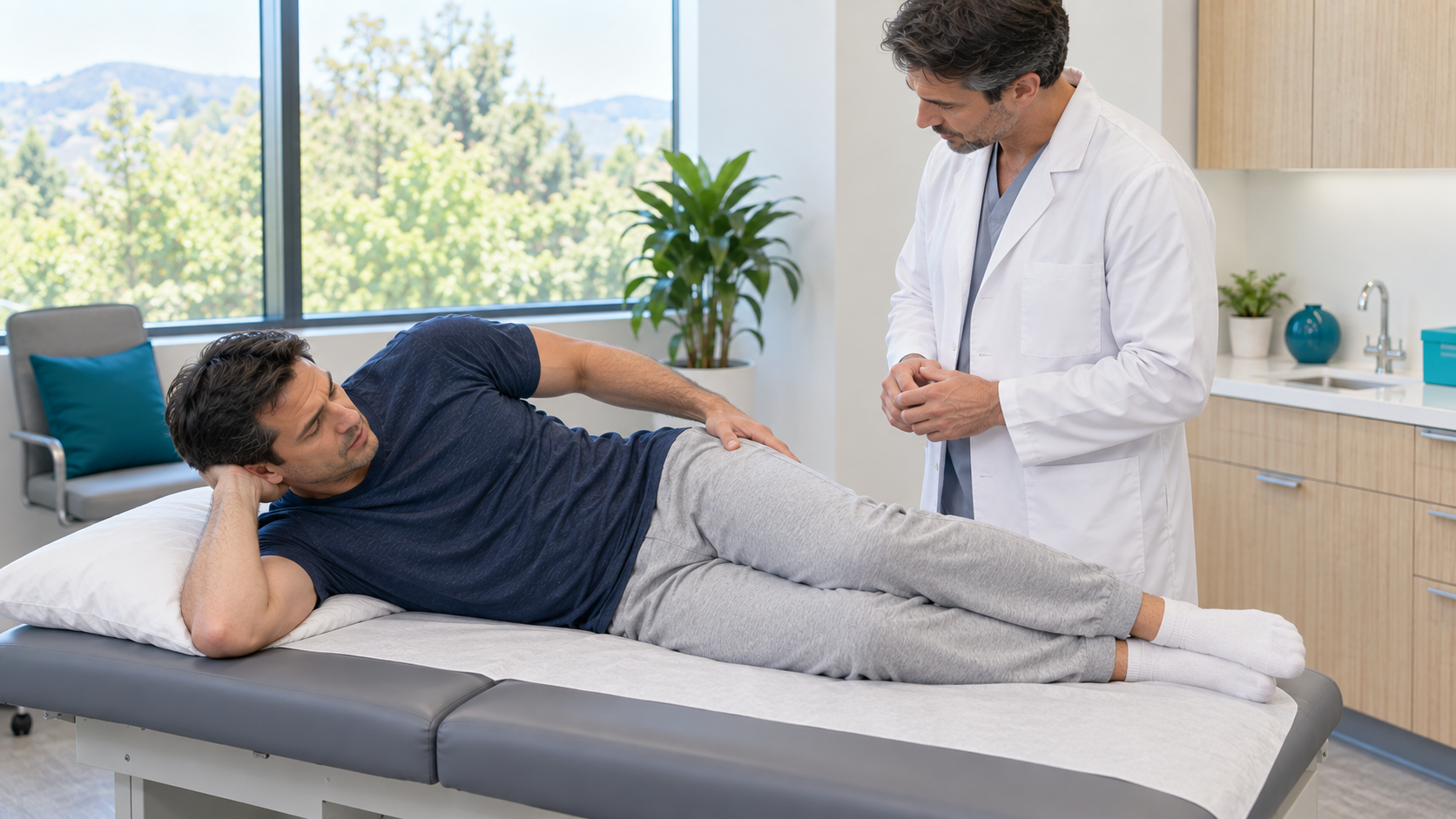
At Dr. Michael Hunter Orthopedic Surgery, evaluating outer hip pain when lying down involves determining which structures around the hip are producing symptoms. Tendons surrounding the greater trochanter, nearby soft tissues, activity-related irritation, and other hip conditions can all contribute to lateral hip pain.
Nighttime symptoms do not automatically mean there is a serious problem inside the hip joint. However, persistent pain—particularly when it also affects walking, stairs, exercise, or everyday activity—deserves appropriate evaluation.
TLDR – Quick Guide
- Outer hip pain at night commonly involves structures around the greater trochanter on the side of the hip.
- Lying directly on the painful side can compress sensitive tendons and surrounding tissues.
- Gluteal tendon problems are a common contributor to lateral hip pain.
- Symptoms may also occur during walking, stairs, running, or prolonged standing.
- Sleeping on the opposite side can sometimes remain uncomfortable because of the position of the painful hip.
- Changing sleep position or using a pillow for support may temporarily reduce irritation.
- Progressive strengthening may help when tendon weakness or reduced load tolerance contributes to symptoms.
- Hip arthritis and other conditions can sometimes produce overlapping pain patterns.
- Persistent nighttime pain should be evaluated when it does not improve with appropriate conservative care.
- Learn more about Trochanteric Pain and treatment considerations for lateral hip symptoms.
Where Does Outer Hip Pain Come From?
Several Structures Surround the Greater Trochanter
The prominent bone on the outside of the upper thigh is called the greater trochanter. Several muscles, tendons, and other soft tissues surround this area.
Pain originating from these structures is often grouped under the term greater trochanteric pain syndrome. Patients commonly describe tenderness or aching directly over the outside of the hip.
Symptoms may occur during:
- Side sleeping
- Walking
- Climbing stairs
- Running
- Standing for long periods
- Getting out of a chair
- Exercising
- Standing primarily on one leg
The exact source of pain can vary, which is why persistent symptoms should be evaluated rather than assuming one specific structure is always responsible.
Why Does Lying on Your Side Make Hip Pain Worse?
Direct Pressure Can Irritate Sensitive Tissues
Side sleeping places direct pressure over the greater trochanter.
When the tendons and surrounding tissues in this area are already irritated, sustained compression can make them more painful. Unlike brief pressure during movement, sleeping can expose the area to compression for an extended period.
This helps explain why someone may tolerate walking during the day yet struggle to remain on the affected side at night.
Changing position can reduce the immediate pressure, although symptoms may return if the underlying problem remains.
What Is Greater Trochanteric Pain Syndrome?
Lateral Hip Pain Often Involves More Than One Structure
Greater trochanteric pain syndrome is a broad term describing pain around the outer portion of the hip.
Historically, lateral hip pain was frequently attributed primarily to inflammation of a nearby bursa. Current clinical understanding recognizes that gluteal tendon problems can also play an important role in many patients.
The pain may remain localized around the greater trochanter or extend along the outer thigh.
Dr. Hunter's Trochanteric Pain resource provides more information about symptoms, diagnosis, and treatment considerations.
Can Hip Tendonitis Cause Pain at Night?
Irritated Tendons Can Be Sensitive to Compression
Tendons from important hip muscles attach near the greater trochanter.
When these tendons become irritated or develop longer-term tendon-related changes, direct compression may produce pain. This can make lying on the affected side particularly uncomfortable.
Patients may also notice symptoms during walking, stairs, running, or movements requiring the hip muscles to stabilize the pelvis.
Learn more about the relationship between activity and tendon symptoms through Dr. Hunter's Hip Tendonitis information.
Why Does the Opposite Side Sometimes Hurt Too?
Hip Position Can Still Compress Sensitive Tendons
Avoiding the painful side does not always eliminate nighttime symptoms.
When lying on the opposite side, the upper leg may drop across the body toward the mattress. This position can place the painful outer hip into adduction and increase compression around sensitive lateral hip structures.
A pillow positioned between the knees and thighs may help maintain a more neutral hip position for some patients.
The objective is to reduce sustained compression rather than forcing the painful hip into a position that repeatedly aggravates symptoms.
Can Sleeping on Your Back Help?
Changing Position May Reduce Direct Pressure
Sleeping on your back can reduce direct pressure on the outer hip.
Some patients find this position more comfortable, particularly during periods when lateral hip symptoms are more sensitive. Pillows may also be used for comfort and positioning depending on individual preferences.
Sleep modifications can help manage symptoms, but they do not necessarily address the reason the tissues became painful.
If symptoms repeatedly return or also interfere with daytime activities, additional treatment may be needed.
Can Too Much Walking Cause Outer Hip Pain?
Repetitive Loading Can Aggravate Lateral Hip Structures
The muscles and tendons around the outer hip help stabilize the pelvis during every step.
A sudden increase in walking distance, running volume, hill training, or other exercise can place greater demands on these structures. If the tissues are not prepared for the increased workload, pain may develop.
Patients may initially notice discomfort only after activity and later begin experiencing symptoms during walking or at night.
Temporarily modifying aggravating activities may help settle symptoms while strength and load tolerance are rebuilt.
Why Do Stairs Make Outer Hip Pain Worse?
The Hip Muscles Work Harder During Step-Ups
Climbing stairs requires the muscles surrounding the hip to generate greater force than level walking.
When the lateral hip tendons are sensitive, repeatedly climbing stairs may increase symptoms. Similar discomfort may occur during step exercises, hiking, or rising from low seating.
This does not necessarily mean these movements should be avoided indefinitely.
As symptoms improve, progressive strengthening can help prepare the hip for increasingly demanding activities.
Can Hip Weakness Contribute to Nighttime Pain?
Reduced Strength Can Affect Load Tolerance
The gluteal muscles play an important role in stabilizing the pelvis during walking and single-leg activities.
When these muscles have reduced strength or endurance, the tendons may have less capacity to tolerate repetitive physical demands. Pain can then cause patients to become less active, potentially contributing to further weakness.
This creates a cycle in which reduced capacity makes activity increasingly difficult.
Progressive rehabilitation can help rebuild strength and improve the hip's tolerance for everyday and recreational demands.
Does Rest Help Outer Hip Pain?
Rest May Reduce Symptoms Without Solving the Entire Problem
Temporarily reducing activities that aggravate the hip can help settle symptoms.
However, complete rest for extended periods may not address weakness or reduced tendon capacity. Patients can become comfortable while inactive only to experience the same pain when walking or exercising again.
Relative rest is often more practical.
This means modifying activities that consistently worsen symptoms while maintaining comfortable movement and gradually rebuilding strength.
Can Physical Therapy Help Outer Hip Pain?
Rehabilitation Can Improve Strength and Load Tolerance
Physical therapy may be useful when tendon irritation, weakness, or movement-control deficits contribute to lateral hip pain.
A rehabilitation program may address:
- Hip strength
- Gluteal muscle function
- Pelvic control
- Lower-extremity strength
- Balance
- Walking tolerance
- Functional movement
- Gradual return to exercise
Exercise should be progressed according to symptoms and functional capacity.
The goal is not simply to reduce nighttime pain but to improve how the hip handles the loads encountered throughout daily life.
Is Outer Hip Pain the Same as Hip Arthritis?
Pain Location Can Provide Useful Clues
Outer hip pain and hip arthritis are not necessarily the same problem.
Hip arthritis often causes pain around the groin or deeper within the joint, although symptoms can vary and may extend into other areas. Arthritis may also cause stiffness and progressive difficulty with everyday activities.
Lateral hip conditions more commonly produce tenderness directly over the outer hip.
Because symptoms can overlap, persistent pain should be evaluated rather than relying on location alone. Dr. Hunter's Hip Pain resource discusses additional conditions that can cause hip symptoms.
Could Joint Degeneration Be Causing Nighttime Hip Pain?
Persistent Pain May Need a Broader Evaluation
Degenerative changes within the hip joint can sometimes cause pain at rest or during the night, particularly when joint symptoms have become more significant.
Patients may also notice stiffness, reduced range of motion, groin pain, or difficulty walking and performing everyday activities.
When symptoms suggest that the joint itself may be involved, an orthopedic evaluation can help distinguish between lateral soft-tissue pain and degenerative joint disease.
Patients can also learn about Hip Pain Treatment for Joint Degeneration and the range of treatment strategies that may be considered.
Can Sports and Exercise Cause Outer Hip Pain?
Training Changes Can Overload the Hip
Athletes may develop lateral hip pain after increasing training volume, intensity, or frequency.
Running mileage, hills, jumping, strength training, and repetitive single-leg activity can all increase demand on the muscles and tendons around the hip.
This does not necessarily mean exercise should stop completely.
A Sports Medicine evaluation can help identify training factors, strength deficits, and movement demands that may be contributing to symptoms while developing a structured return-to-activity plan.
Why Does Outer Hip Pain Keep Coming Back?
Symptom Relief Does Not Always Restore Capacity
Recurring pain can occur when the aggravating activity is temporarily removed but the underlying strength or load-tolerance problem is not addressed.
A patient may stop running or walking long distances until nighttime symptoms disappear, then immediately return to the previous activity level. The hip may not yet be prepared for those demands.
Repeated compression during sleep can also continue irritating sensitive tissues.
Long-term improvement may therefore require a combination of sleep-position modifications, appropriate activity management, strengthening, and gradual reloading.
What Can You Do About Outer Hip Pain at Night?
Reduce Irritation While Addressing the Cause
Simple modifications may help reduce nighttime symptoms while the underlying problem is being treated.
Depending on the individual, helpful strategies may include:
- Avoiding prolonged direct pressure on the painful hip
- Trying a back-sleeping position
- Using a pillow between the knees when side sleeping
- Avoiding positions that allow the painful leg to drop far across the body
- Temporarily modifying aggravating exercise
- Gradually strengthening the hip
- Reintroducing walking and exercise progressively
These measures should complement an appropriate diagnosis rather than substitute for evaluation when pain remains persistent.
When Should You See an Orthopedic Specialist?
Persistent Nighttime Pain Should Not Be Ignored
Occasional mild hip discomfort may improve with activity and sleep modifications, but persistent pain deserves further evaluation.
Consider seeing an orthopedic specialist when you experience:
- Nighttime pain that regularly interrupts sleep
- Persistent tenderness over the outer hip
- Increasing pain during walking
- Difficulty climbing stairs
- Reduced hip mobility
- Noticeable weakness
- Symptoms that continue despite activity modification
- Pain that repeatedly returns with exercise
- Significant symptoms following an injury
Evaluation can help distinguish tendon-related lateral hip pain from arthritis, joint problems, or other potential causes.
Key Takeaways
- Outer hip pain when lying down commonly involves structures around the greater trochanter.
- Direct pressure from side sleeping can compress sensitive tendons and surrounding tissues.
- Gluteal tendon problems can contribute to persistent lateral hip pain.
- Sleeping on the opposite side may still aggravate symptoms if the painful hip drops across the body.
- A pillow between the knees may help reduce compression for some patients.
- Walking, stairs, running, and hills can aggravate lateral hip symptoms because the hip muscles work to stabilize the pelvis.
- Rest may reduce symptoms without rebuilding strength or tendon load tolerance.
- Progressive rehabilitation can help restore hip strength and function.
- Hip arthritis and other joint conditions can sometimes produce overlapping symptoms.
- Persistent nighttime pain or worsening functional limitations warrant orthopedic evaluation.
FAQs
Why does my outer hip hurt when I sleep on my side?
Side sleeping places sustained pressure directly over the greater trochanter and surrounding soft tissues. If the gluteal tendons or nearby structures are sensitive, this compression can increase pain during the night. Changing position and addressing the underlying cause of the irritation may help reduce symptoms.
Will outer hip pain go away on its own?
Mild symptoms associated with a temporary increase in activity may improve when the aggravating load is reduced. Persistent tendon-related pain may require strengthening, activity modification, and gradual reloading rather than rest alone. Ongoing or worsening symptoms should be evaluated to confirm the cause of the pain.
What is the best sleeping position for outer hip pain?
Sleeping on the back may reduce direct pressure on the painful outer hip for some patients. When sleeping on the opposite side, placing a pillow between the knees and thighs may help prevent the painful hip from dropping across the body. The most comfortable position varies, so sleep modifications should be adjusted according to individual symptoms.
Can hip tendonitis cause pain while lying down?
Hip tendon problems can cause pain while lying down, particularly when direct pressure is placed over sensitive structures on the outside of the hip. Symptoms may also occur during walking, stairs, running, or prolonged standing because these activities load the affected tendons. Persistent symptoms should be assessed to determine whether tendonitis or another hip condition is responsible.
When should I worry about hip pain at night?
Hip pain that repeatedly interrupts sleep, becomes progressively worse, or significantly affects walking and everyday activity deserves medical evaluation. New severe pain, inability to bear weight, or symptoms following significant trauma should be assessed promptly. An orthopedic specialist can determine whether the symptoms originate from lateral hip tissues, the joint itself, or another condition.
Ready to discuss your hip or knee concerns with Dr. Hunter?